
Routing Protocols
Core concepts to real-world configuration, best practices, and protocol trade-offs
🌐 What Are Routing Protocols?
In any IP network, data must travel from a source to a destination — often crossing multiple routers along the way. A routing protocol is a set of rules and algorithms that routers use to communicate with each other, share information about the network topology, and determine the most efficient path for forwarding packets.
Unlike a static route — which a network engineer manually enters into a router’s configuration — a dynamic routing protocol allows routers to automatically discover neighbors, exchange network reachability information, and adapt to changes such as link failures or new subnets being added. This makes routing protocols essential for any network beyond the smallest of environments.
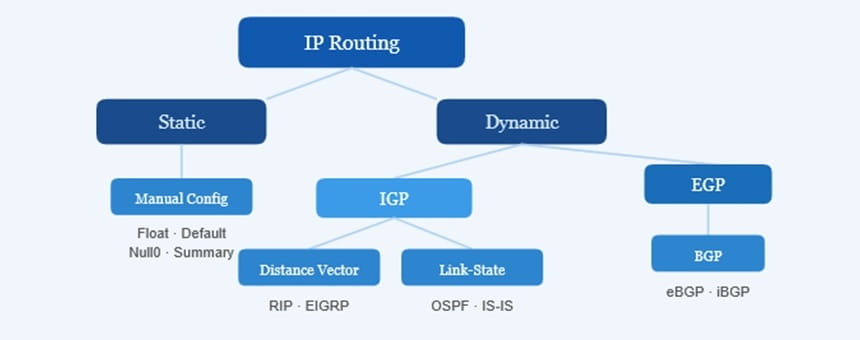
There are two primary categories of routing: static routing and dynamic routing. Static routes are manually configured and do not change unless an administrator modifies them. Dynamic routing protocols automate this process, making them the backbone of modern enterprise, service provider, and internet infrastructure.
Classification of Routing Protocols
Routing protocols are broadly classified into two groups based on their operational scope:
| Category | Full Name | Examples | Scope |
|---|---|---|---|
| IGP | Interior Gateway Protocol | OSPF, EIGRP, RIP, IS-IS | Within a single Autonomous System (AS) |
| EGP | Exterior Gateway Protocol | BGP | Between different Autonomous Systems |
Within IGPs, protocols are further divided by their algorithm type: Distance Vector protocols (such as RIP and EIGRP) and Link-State protocols (such as OSPF and IS-IS). Each approach has distinct characteristics, advantages, and use cases.
🧩 Key Components
Understanding routing protocols requires familiarity with the fundamental building blocks that every protocol relies on. These components determine how a protocol discovers neighbours, builds its topology database, and selects the best path.
Routing Table
The local database on each router listing known destination networks, the next-hop address, outgoing interface, and the metric for each route.
Metric
A value used to compare routes to the same destination. Different protocols use different metrics — hop count (RIP), bandwidth & delay (EIGRP), cost (OSPF).
Autonomous System (AS)
A collection of IP networks under a single administrative domain. IGPs operate within one AS; BGP connects multiple ASes.
Neighbour Adjacency
The relationship formed between two routers running the same protocol, enabling them to exchange routing information reliably.
Administrative Distance
A Cisco-specific value (0–255) used when multiple routing sources advertise the same network. Lower AD = more trusted source.
Topology / Link-State DB
Used by link-state protocols (OSPF, IS-IS) — a complete map of the network that each router independently builds from LSAs/LSPs.
Convergence Time
The time required for all routers in the network to agree on a consistent view of the topology after a change occurs.
Algorithm (SPF / DUAL)
The mathematical engine powering path selection. OSPF uses Dijkstra’s SPF; EIGRP uses the Diffusing Update Algorithm (DUAL).
Administrative Distance Reference Table
When a router learns about the same network from multiple sources, it uses Administrative Distance to select the preferred route:
| Routing Source | Default AD | Notes |
|---|---|---|
| Connected Interface | 0 | Most trusted — directly attached |
| Static Route | 1 | Manually configured by admin |
| EIGRP (Summary) | 5 | Summarised EIGRP route |
| eBGP | 20 | External BGP peer |
| EIGRP (Internal) | 90 | Most preferred IGP on Cisco |
| OSPF | 110 | Open standard, widely deployed |
| IS-IS | 115 | Common in service provider networks |
| RIP | 120 | Legacy; limited to 15 hops |
| iBGP | 200 | Internal BGP peer |
| Unknown / Unreachable | 255 | Route is never used |
⚙️ How Routing Protocols Work
Despite their differences, all dynamic routing protocols share a common operational lifecycle. Understanding these stages — neighbour discovery, information exchange, route calculation, and convergence — is essential for troubleshooting and design.
Routers send Hello packets on enabled interfaces to discover and verify neighbouring routers running the same protocol. Parameters such as area ID, AS number, authentication, and timers must match for adjacency to form.
Once neighbours are established, routers exchange routing information. Distance Vector protocols send their full routing table; Link-State protocols flood Link-State Advertisements (LSAs) describing each router’s directly connected links.
Each router runs its algorithm independently. OSPF executes Dijkstra’s Shortest Path First (SPF) against its link-state database to build a loop-free tree rooted at itself. EIGRP uses DUAL to identify a Successor route and a Feasible Successor as a backup.
The best routes (lowest metric) are installed into the router’s Routing Information Base (RIB), also known as the routing table. The Forwarding Information Base (FIB) in the data plane is then updated for packet forwarding.
Routers send periodic Hellos or keepalives. If a neighbour stops responding within the Dead/Hold timer window, the local router marks the link as down, removes affected routes, recalculates, and floods topology change notifications to neighbours.
Convergence is achieved when all routers in the network have a consistent, loop-free view of the topology. Fast convergence is critical for high-availability environments — OSPF and EIGRP converge in seconds; modern BGP deployments use BFD and route dampening to accelerate this.
Distance Vector vs Link-State: A Conceptual Comparison
Routing by Rumour! Distance Vector protocols are sometimes described as “routing by rumour” — each router only knows what its neighbours tell it, not the full network topology. This can lead to slower convergence and routing loops without mechanisms like Split Horizon or Poison Reverse.
In contrast, Link-State protocols give every router a complete map of the network. Each router then independently runs the SPF algorithm to compute the shortest path tree. This results in faster convergence and eliminates routing loops, at the cost of higher memory and CPU requirements.
R1 (10.0.0.1) ──── Serial 0/0 ────── R2 (10.0.0.2)
| Lo0: 192.168.1.0/24 | Lo0: 192.168.2.0/24
| |
GE0/1 GE0/1
| |
R3 (10.0.1.1) ──── GE0/0 ──────── R4 (10.0.1.2)
| Lo0: 192.168.3.0/24 | Lo0: 192.168.4.0/24
All links in OSPF Area 0 (Backbone)
SPF root: each router builds its own shortest path tree
Sample OSPF Configuration (Cisco IOS)
! Enable OSPF process 1 on R1

router ospf 1

router-id 1.1.1.1

network 10.0.0.0 0.0.0.255 area 0

network 192.168.1.0 0.0.0.255 area 0

passive-interface Loopback0     ! Do not send Hellos on stub

auto-cost reference-bandwidth 10000  ! 10 Gbps baseline! Verify neighbours and routing table

show ip ospf neighbor

show ip route ospf

show ip ospf database
auto-cost reference-bandwidth to match your highest-speed link (e.g., 10000 for 10 Gbps). By default, Cisco uses 100 Mbps, which means FastEthernet, GigabitEthernet, and 10GigabitEthernet would all share the same OSPF cost of 1 — hiding real topology differences.📊 Usage and Functions
Routing protocols serve different purposes depending on the network environment, scale, and operational requirements. Below is a comprehensive overview of the most widely deployed protocols, their typical use cases, and key characteristics.
Protocol Scalability & Convergence Speed
Protocol Function Reference
| Protocol | Type | Algorithm | Metric | Best Use Case |
|---|---|---|---|---|
| RIP v2 | IGP / Distance Vector | Bellman-Ford | Hop Count (max 15) | Small legacy networks, lab environments |
| EIGRP | IGP / Hybrid (Advanced DV) | DUAL | Bandwidth, Delay, Load, Reliability | Cisco-centric enterprise networks |
| OSPF v2/v3 | IGP / Link-State | Dijkstra (SPF) | Cost (based on bandwidth) | Multi-vendor enterprise & campus |
| IS-IS | IGP / Link-State | Dijkstra (SPF) | Administrative metric | Service provider core, large-scale ISP |
| BGP-4 | EGP / Path Vector | Best Path Selection | AS-Path, MED, Local Pref, Weight | Internet routing, multi-homed enterprises |
Core Functions of Routing Protocols
Network Discovery: Routing protocols automatically discover all reachable networks within their domain, removing the need for administrators to manually enumerate every subnet.
Path Selection: Using their respective metrics and algorithms, routing protocols select the optimal path among potentially multiple routes to the same destination, balancing speed, reliability, and efficiency.
Load Balancing: Protocols such as EIGRP and OSPF support equal-cost multipath (ECMP) load balancing, distributing traffic across multiple paths simultaneously. EIGRP additionally supports unequal-cost load balancing via the variance command.
Redundancy & Failover: Dynamic routing protocols detect link or neighbour failures and rapidly recalculate alternative paths, providing automatic failover without manual intervention.
Policy and Traffic Engineering: BGP provides extensive path manipulation capabilities through attributes such as Local Preference, MED, Communities, and AS-Path prepending — enabling fine-grained traffic engineering across internet-scale topologies.
✅ Best Practices
Deploying routing protocols correctly from the outset is far less costly than troubleshooting a misconfigured production network. The following best practices reflect hard-won lessons from enterprise and service provider environments.
- Choose the Right Protocol for the Scale and Environment. Use OSPF or IS-IS for large multi-vendor networks. Use EIGRP in Cisco-only environments where fast convergence and ease of configuration are priorities. Never deploy RIP in production networks with more than 10 routers.
- Always Configure a Unique Router-ID. Explicitly set the router-id on every OSPF and EIGRP router using a stable Loopback interface IP. Relying on automatic election can cause instability if physical interfaces go up and down.
- Use Passive Interfaces on Stub Networks. Apply
passive-interfaceto any interface not connected to another router (such as access-layer LANs). This prevents unnecessary Hello packets and reduces attack surface. - Implement Route Summarisation at Area or Region Boundaries. Summarising routes reduces the size of routing tables, decreases SPF computation load, and limits the blast radius of topology changes to a local area.
- Authenticate All Routing Protocol Sessions. Use MD5 or SHA authentication (where supported) to prevent unauthorised routers from injecting false routing information. BGP sessions should always use MD5 TCP authentication.
- Tune Timers Appropriately for the Environment. Default Hello and Dead timers may be too slow for time-sensitive applications. In LAN environments, OSPF Dead timers can be lowered to 4 seconds (1-second Hellos). Combine with BFD for sub-second failure detection.
- Baseline and Document Your Routing Design. Maintain up-to-date network diagrams, IP addressing plans, and routing policy documentation. A well-documented design significantly reduces mean time to repair (MTTR) during incidents.
- Avoid Redistribution Where Possible — and Control It When Necessary. Redistributing between multiple routing domains introduces complexity and the risk of routing loops or suboptimal paths. Always apply route-maps with
matchandsetclauses to control what is redistributed. - Enable BFD for Fast Failure Detection. Bidirectional Forwarding Detection (BFD) provides sub-50ms failure detection independent of the routing protocol’s own timers, dramatically improving convergence time for critical links.
- Regularly Verify Routing Tables and Neighbour Adjacencies. Incorporate
show ip route,show ip ospf neighbor, andshow bgp summaryinto routine operational checks and monitoring dashboards.
⚖️ Advantages & Disadvantages
No single routing protocol is perfect for every situation. Understanding the trade-offs helps engineers make informed design decisions.
Dynamic Routing Protocols (General)
✔ Advantages
- Automatic network discovery — no manual route entry required
- Self-healing: automatically reroutes around failures without operator intervention
- Scales efficiently to large and complex topologies
- Reduces human error from manual configuration
- Supports load balancing across equal (and in some cases unequal) cost paths
- Provides redundancy and path diversity out of the box
- Adapts in near-real-time to topology changes
✘ Disadvantages
- Consumes additional CPU, memory, and bandwidth resources
- More complex to configure, troubleshoot, and secure than static routing
- Routing loops are possible without proper design (especially Distance Vector)
- Protocol-specific knowledge required — each protocol has unique behaviours
- Misconfiguration can propagate incorrect routes network-wide rapidly
- Some protocols (e.g., BGP) have lengthy convergence times by default
OSPF – Open Shortest Path First
✔ Advantages
- Open standard — fully vendor-neutral and interoperable
- Fast convergence using SPF algorithm and incremental LSA updates
- Hierarchical design with Areas reduces overhead and SPF scope
- Supports VLSM and CIDR natively
- Scales well in enterprise environments with proper area design
- Widely documented — extensive community support and certification coverage
✘ Disadvantages
- Higher memory and CPU demands than Distance Vector protocols
- Complex to design correctly at scale (area design, DR/BDR election, LSA types)
- All routers in an area must have identical link-state databases
- Misconfigured area boundaries can cause black-hole routing
- Requires careful MTU matching on all adjacency links
BGP – Border Gateway Protocol
✔ Advantages
- Proven internet-scale protocol — handles full global routing table (900k+ prefixes)
- Rich policy control through attributes (Local Pref, MED, Communities, etc.)
- Supports multi-homing and traffic engineering with precision
- Carries additional NLRI families — VPNv4, IPv6, L2VPN (MPLS)
- Stable and loop-free by design via AS-Path attribute
✘ Disadvantages
- Slowest convergence of all routing protocols by default
- Highly complex — steep learning curve for policy and attribute manipulation
- BGP session flaps can cause widespread internet instability (route leaks)
- Requires a well-designed IGP as an underlay within each AS
- Full internet routing table requires significant RAM (4 GB+ recommended)
EIGRP – Enhanced Interior Gateway Routing Protocol
✔ Advantages
- Extremely fast convergence — DUAL provides near-instant failover via Feasible Successor
- Supports unequal-cost load balancing (unique among common IGPs)
- Sends partial updates only when topology changes — efficient bandwidth use
- Easy to configure — single
networkstatement covers multiple interfaces - Now available as an open standard (RFC 7868)
✘ Disadvantages
- Historically Cisco-proprietary — limited third-party implementation experience
- DUAL can cause Stuck-in-Active (SIA) issues in large, unstable topologies
- Composite metric (K-values) can be difficult to tune correctly
- Less widely documented in non-Cisco literature compared to OSPF
🎯 Conclusion
Routing protocols are the nervous system of modern IP networks. Without them, every network path would require manual configuration and every failure would demand immediate human intervention. From the simplicity of RIP in a small lab to the global complexity of BGP on the internet, each protocol has been designed to solve specific problems at specific scales.
As a network engineer — whether you are preparing for the Cisco CCNA examination or designing a production enterprise network — a thorough understanding of how routing protocols discover neighbours, exchange topology information, calculate optimal paths, and converge after failures is foundational knowledge that underpins everything else in networking.
Choose your routing protocol based on your network’s scale, vendor environment, performance requirements, and operational complexity tolerance. Implement best practices from day one — authenticate sessions, document your design, tune your timers, and monitor your routing tables continuously.
The right routing protocol, correctly implemented, becomes invisible. Traffic flows, failures self-heal, and the network operates exactly as designed — and that is the hallmark of excellent network engineering.
📖 Glossary
Key terms and acronyms used throughout this article, provided as a quick reference for networking professionals.